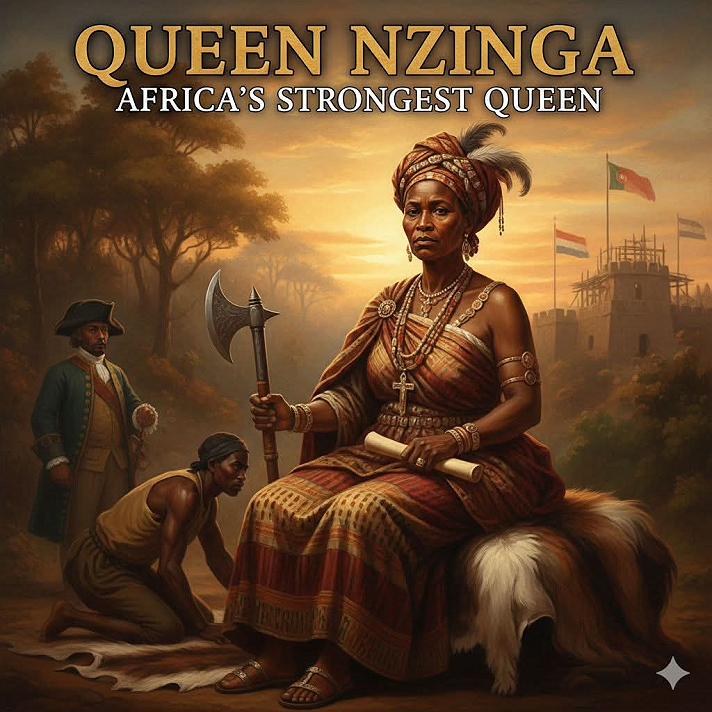




Queen Nzinga was one of the most formidable rulers in 17th-century Africa.
Queen of the Ndongo and Matamba kingdoms (in present-day Angola), Nzinga Mbande became one of the strongest opponents of Portuguese expansion into Central Africa.
In 1622, she first appeared on the political stage when her brother, the Ngola (king) of Ndongo, sent her to negotiate with the Portuguese governor in Luanda. Determined to establish equality in diplomacy, Nzinga famously refused to sit on the floor before the Portuguese representative. Instead, she had one of her attendants kneel so she could sit at eye level with the governor, a symbolic statement that she represented a sovereign state.
She converted to Christianity during negotiations and took the name Dona Ana de Sousa, using diplomacy as strategically as she used warfare.
When her brother died in 1626, Nzinga became ruler. She reorganized her kingdom, formed alliances with neighboring states, and later aligned with the Dutch when they challenged Portuguese power in the region. In 1647, with Dutch support, she helped defeat a Portuguese army. Even after the Dutch withdrew, she continued resisting Portuguese expansion for decades.
Well into her sixties, Nzinga personally led troops in battle and organized long-term resistance strategies that shaped the region’s political future.
She ruled for nearly 40 years and died peacefully in 1663, having preserved significant autonomy for her kingdom during one of the most turbulent periods in Central African history.
Queen Nzinga remains one of Africa’s most studied and respected monarchs remembered for her diplomacy, military leadership, and political intelligence. #Africa
Queen of the Ndongo and Matamba kingdoms (in present-day Angola), Nzinga Mbande became one of the strongest opponents of Portuguese expansion into Central Africa.
In 1622, she first appeared on the political stage when her brother, the Ngola (king) of Ndongo, sent her to negotiate with the Portuguese governor in Luanda. Determined to establish equality in diplomacy, Nzinga famously refused to sit on the floor before the Portuguese representative. Instead, she had one of her attendants kneel so she could sit at eye level with the governor, a symbolic statement that she represented a sovereign state.
She converted to Christianity during negotiations and took the name Dona Ana de Sousa, using diplomacy as strategically as she used warfare.
When her brother died in 1626, Nzinga became ruler. She reorganized her kingdom, formed alliances with neighboring states, and later aligned with the Dutch when they challenged Portuguese power in the region. In 1647, with Dutch support, she helped defeat a Portuguese army. Even after the Dutch withdrew, she continued resisting Portuguese expansion for decades.
Well into her sixties, Nzinga personally led troops in battle and organized long-term resistance strategies that shaped the region’s political future.
She ruled for nearly 40 years and died peacefully in 1663, having preserved significant autonomy for her kingdom during one of the most turbulent periods in Central African history.
Queen Nzinga remains one of Africa’s most studied and respected monarchs remembered for her diplomacy, military leadership, and political intelligence. #Africa