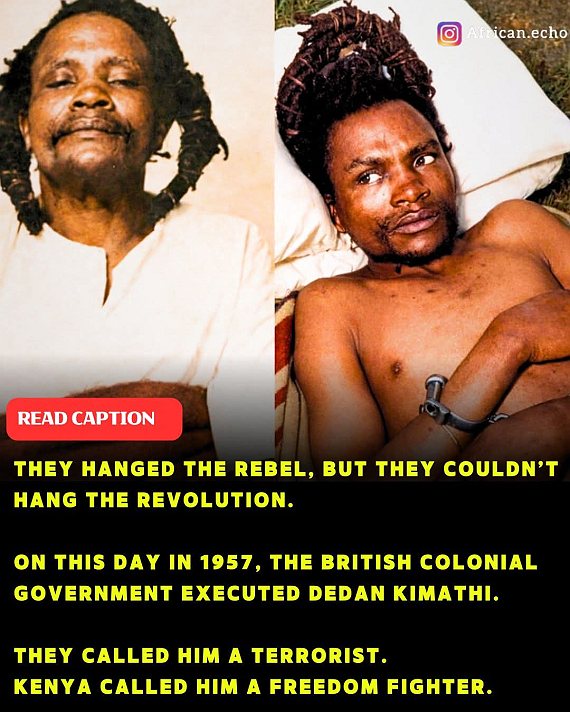



They Hanged Him at Dawn — But They Couldn’t Hang the Revolution.
On this day in 1957, the British colonial government executed Dedan Kimathi.
They called him a terrorist.
Kenya called him a freedom fighter.
Kimathi was the leader of the Kenya Land and Freedom Army (KLFA), the armed wing of what the British labeled the “Mau Mau” uprising. But this wasn’t random violence. It was resistance.
Land had been stolen.
Families had been pushed off fertile soil.
Africans were forced into labor systems that benefited settlers.
The forests became headquarters. The mountains became refuge. And Kimathi became a symbol.
Captured in 1956, he was tried and sentenced to death. On February 18, 1957, he was hanged by the same empire that claimed it was bringing “civilization.”
But here’s the part history textbooks often soften: the Mau Mau uprising shook the British Empire. It exposed the brutality of colonial rule—detention camps, torture, collective punishment. Decades later, Britain would admit abuses took place during the emergency period.
So ask yourself:
Who gets to define “terrorist”?
Who writes the first version of history?
And why do empires always rename resistance as crime?
Kimathi died before seeing Kenya’s independence in 1963. But his execution did not end the struggle. It intensified it.
Today, statues stand where gallows once did. Memory defeated propaganda.
Follow @african.echo for more powerful African history and untold stories.
Support the movement by getting our debut book, “20 African Wonder Women That Changed History.”
Because reclaiming history is an act of resistance.😭😭😭
On this day in 1957, the British colonial government executed Dedan Kimathi.
They called him a terrorist.
Kenya called him a freedom fighter.
Kimathi was the leader of the Kenya Land and Freedom Army (KLFA), the armed wing of what the British labeled the “Mau Mau” uprising. But this wasn’t random violence. It was resistance.
Land had been stolen.
Families had been pushed off fertile soil.
Africans were forced into labor systems that benefited settlers.
The forests became headquarters. The mountains became refuge. And Kimathi became a symbol.
Captured in 1956, he was tried and sentenced to death. On February 18, 1957, he was hanged by the same empire that claimed it was bringing “civilization.”
But here’s the part history textbooks often soften: the Mau Mau uprising shook the British Empire. It exposed the brutality of colonial rule—detention camps, torture, collective punishment. Decades later, Britain would admit abuses took place during the emergency period.
So ask yourself:
Who gets to define “terrorist”?
Who writes the first version of history?
And why do empires always rename resistance as crime?
Kimathi died before seeing Kenya’s independence in 1963. But his execution did not end the struggle. It intensified it.
Today, statues stand where gallows once did. Memory defeated propaganda.
Follow @african.echo for more powerful African history and untold stories.
Support the movement by getting our debut book, “20 African Wonder Women That Changed History.”
Because reclaiming history is an act of resistance.😭😭😭