



The Reader Who Became the Burning Word
The third image is not a continuation of the apocalypse but its transfiguration. Where the earlier visions showed a world reduced to cinders and a solitary reader clinging to the last ember of meaning, this final frame reveals the secret hidden inside the book all along: the fire was never merely destruction; it was purification, and the reader was never merely enduring; he was becoming.
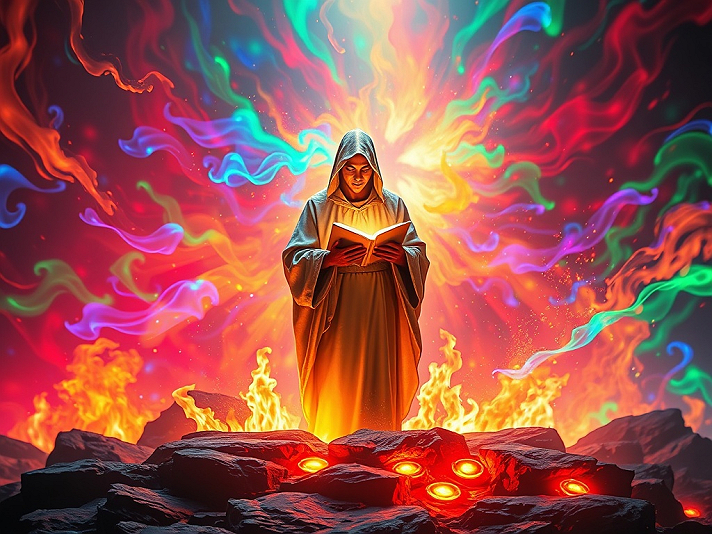
He stands in exactly the same posture—hooded, robed, hands cradling the open volume—but everything else has changed. The jagged black rocks remain, yet now they cradle pools of molten light, as though the earth itself has opened its veins and begun to bleed gold. Flames still rise, but they rise upward into a vortex of impossible color: emerald, sapphire, amethyst, colors that have no name in any spectrum known to physics. These hues do not scatter; they spiral inward, drawn toward the figure as if he were the eye of a cosmic hurricane. The smoke that once choked the sky has become auroral ribbon, living light that dances rather than devours. At the center of the maelstrom, directly above the reader’s head, a white-gold radiance bursts outward in perfect radial symmetry, the visual equivalent of a choir holding a single, endless note of triumph.
And the reader himself is no longer merely untouched by the chaos; he is its source. Light pours from the pages he holds, not reflected firelight but generated brilliance, as though each word on the parchment has ignited into pure spectrum. His robe, once the dull gray-brown of ash, now shimmers with the soft luster of moonlit pearl. The hood has slipped back just enough to reveal a face no longer etched with resignation but lifted in quiet, almost childlike wonder. His eyes are closed, yet he is not blind; he has turned inward to the place where sight becomes vision. A faint smile touches his lips—the first emotion the series has allowed him—and it is the smile of someone who has finally understood the last sentence of a long and difficult text.
This is the moment of apotheosis. The book was never a refuge from the burning world; it was the kindling. Every letter the reader traced with his eyes was a spark, every paragraph a coal banked against the coming blaze. While the first two images showed the world ending in fire, this third image reveals that some fires do not consume—they refine. The inferno was always the crucible, and the reader its willing ore. What emerges is not a man who has survived judgment but a man who has become the judgment’s fulfillment: the Word made fire, the fire made flesh, the flesh made light.
The composition reinforces the revelation. Where the earlier images used negative space to isolate the figure, here every inch of canvas pulses with energy that flows toward him and through him. The flames beneath his feet are no longer random; they form a perfect circle, a mandorla of living fire that elevates him above the merely terrestrial. The colorful auroras are not background decoration but the visible emanation of his reading, as though each syllable he pronounces rewrites the electromagnetic field of reality itself. Even the rocks have joined the liturgy: their molten hearts beat in slow, deliberate rhythm, marking time for a cosmos that has remembered its original purpose.
Theologically, the image is almost too bold. It risks blasphemy by suggesting that a single human act—reading—can stand at the center of universal transfiguration. Yet that is precisely its claim. The book is no longer merely scripture, grimoire, or manifesto; it is the Book of Life whose final page contains not an index but an invitation: Read me, and I will read you into being. The reader who accepts becomes co-author of the next creation. His closed eyes see farther than any open gaze ever could, because they see from the inside of the light.
Where the first images asked, “What do you do when the world burns?” this final image answers, “You finish the sentence.” The apocalypse was never the end of the story; it was the margin where the old world ran out of room, forcing the text to continue on the other side of the fire. The reader who persists past the last period discovers that the flames were only the illuminator’s gold leaf, applied by divine hand to make the letters glorious. What began as a solitary act of defiance has become the pivot on which all reality turns, the moment when entropy reverses and chaos remembers it was once pronounced “very good.”
There is no more fear here, no more ash, no more distance between the reader and the read. The book is open at its exact center, its pages no longer paper but living light, and the man who holds it has become the binding that keeps heaven and earth from flying apart. The colors whirl faster now, the flames rise higher, the rocks sing with liquid voices, and still he reads—slowly, carefully, lovingly—because every word he speaks is another world spared from the dark. This is not the last reader in the burning world. This is the first reader of the world made new, and the fire itself has become his halo.